
“You have arranged all things by measure and number and weight”
Wisdom 11:20
Number, calculation, measure, geometry and statistics
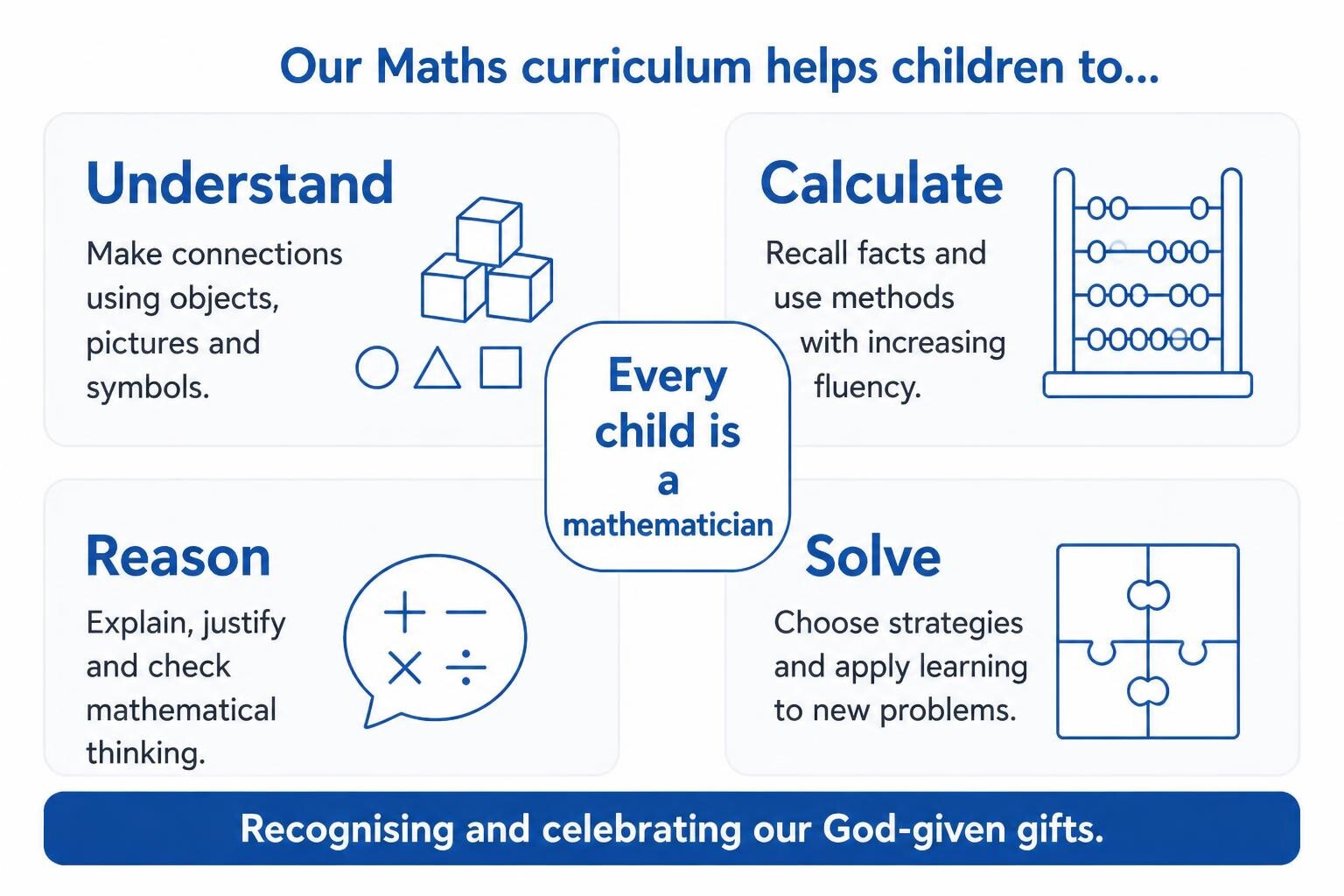
Intent
At our school, we believe that all children can achieve and enjoy success in mathematics. Our mathematics curriculum is designed to provide all pupils with a secure understanding of mathematical concepts, procedural fluency and problem-solving skills.
We aim to:
- Develop children’s fluency in number and calculation through regular practice and mastery approaches.
- Build conceptual understanding through the Concrete, Pictorial and Abstract (CPA) approach.
- Enable children to reason mathematically, justify their thinking and make connections between mathematical ideas.
- Ensure progression in knowledge and skills through a carefully structured curriculum.
- Provide opportunities for children to apply their learning in a variety of meaningful and real-life contexts.
- Develop positive attitudes towards mathematics so that children become confident and independent learners.
By the time pupils leave our school, we aim for them to:
- Have a strong understanding of key mathematical concepts and procedures.
- Demonstrate fluency and accuracy in calculation.
- Use mathematical vocabulary confidently and accurately.
- Apply mathematical knowledge to solve problems and explain their reasoning.
- Make links between different areas of mathematics.
- Approach challenges with resilience and confidence.
- Be well prepared for the next stage of their mathematical education.
Implementation
Our mathematics curriculum is implemented through carefully sequenced teaching, rooted in the principles of teaching for mastery and informed by NCETM guidance. We establish a consistent approach across the school while adapting teaching to pupils’ needs.
-
Coherent planning and progression: In Reception, teaching draws on NCETM Mastering Number, supplemented with White Rose resources. In Years 1–6, teachers use NCETM Curriculum Prioritisation materials, supplemented with White Rose to support full curriculum coverage. Learning builds in small, connected steps, enabling pupils to develop secure understanding over time.
-
Teaching for mastery: Pupils explore concepts in depth, with carefully designed examples, variation and questioning helping them identify patterns and make connections. Teachers provide support and challenge through scaffolding, reasoning and increasingly demanding applications, adapting learning where individual needs require it.
-
Clear learning intentions: Teachers identify the essential knowledge, vocabulary, representations and intended outcomes for each unit, building on prior learning and preparing pupils for their next steps.
-
Fluency, reasoning and problem-solving: These are developed together throughout the curriculum. In Years 1–3, additional Mastering Number sessions strengthen number sense and fluency alongside pupils’ main mathematics lessons.
-
Assessment and responsive teaching: Questioning, observation and discussion help teachers check understanding and identify misconceptions. Teaching is adjusted in response, with additional practice and targeted support provided where needed.
-
Representations and practical resources: Carefully chosen manipulatives, images and symbols help pupils understand mathematical structures. Teachers explicitly connect concrete, pictorial and abstract representations, revisiting them as needed to deepen understanding.
-
Mathematical language and discussion: Pupils are taught to use precise vocabulary to explain their thinking, justify answers and consider different approaches. Purposeful discussion supports reasoning and helps teachers assess understanding.
-
Confidence and independence: Pupils have regular opportunities to apply their learning, select strategies and reflect on solutions. Mistakes are used as opportunities to learn, helping children develop resilience and confidence as mathematicians.
Impact
Our mathematics curriculum develops confident, fluent and resilient mathematicians who build secure understanding and apply their knowledge in a range of contexts. Pupils make connections between mathematical ideas, use mathematical vocabulary to explain their thinking and develop increasing independence in reasoning and problem-solving.
We evaluate the impact through ongoing assessment, pupils’ work, pupil voice and monitoring of teaching and learning. Reviewing attainment and progress helps us identify strengths, address gaps and refine our provision. This ensures that teaching responds to pupils’ needs and supports their readiness for the next stage of mathematical learning.