
“Pleasant words are like a honeycomb”
Proverbs 16:24
Word patterns, sentence structure and punctuation
Intent
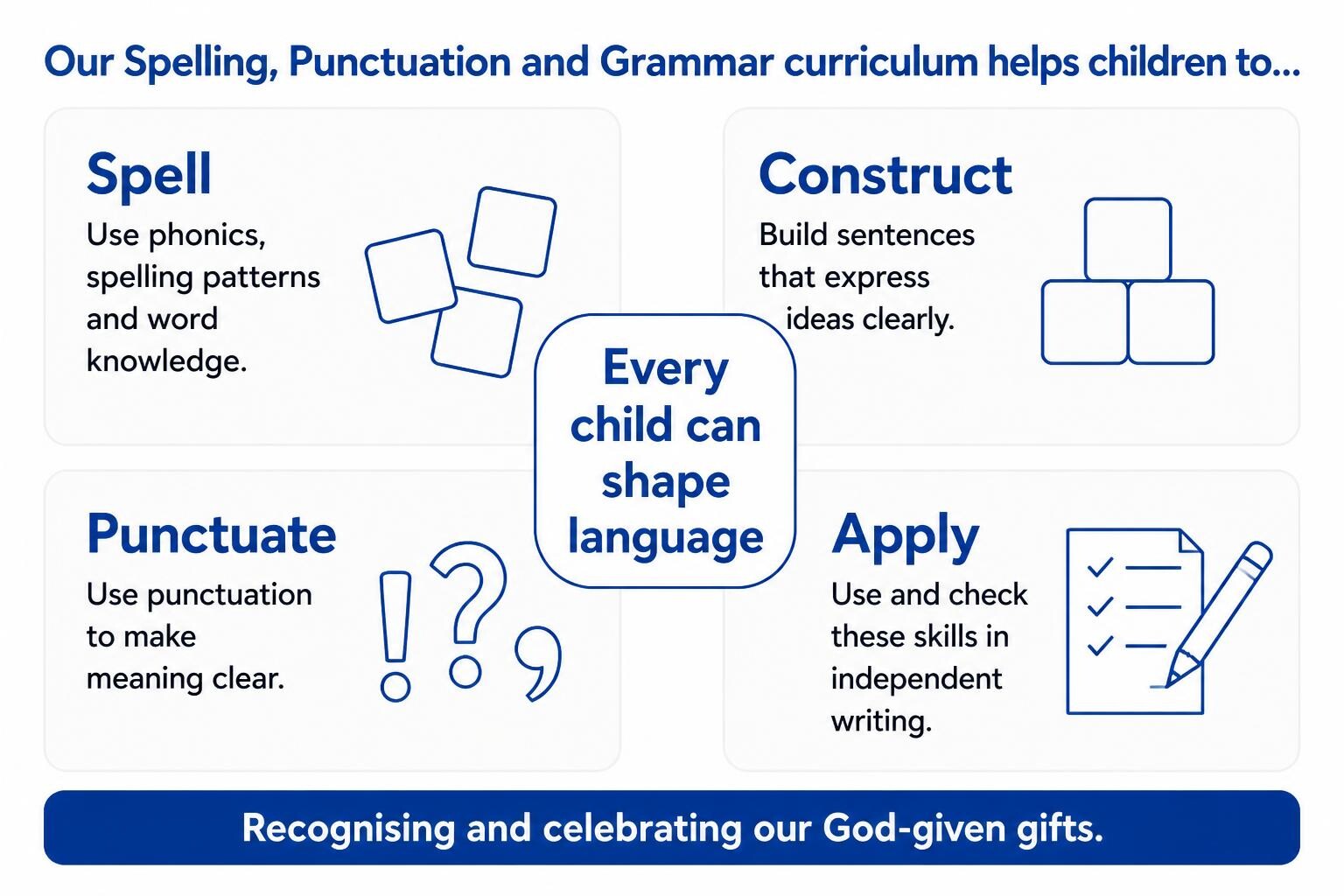
At St Mary’s Catholic Primary School, spelling, punctuation and grammar give children the tools to express their ideas clearly, accurately and creatively. We want pupils to understand how language works and make thoughtful choices that suit their audience and purpose.
Our curriculum builds secure knowledge of sounds, spelling patterns, word structure, sentences and punctuation. Through meaningful links with reading, writing and spoken language, children develop the vocabulary to discuss language and the confidence to experiment with it. We nurture independent writers who can apply what they know, recognise errors and refine their work with pride.
Implementation
Our teaching follows a carefully sequenced progression, building from oral sentence formation and phonics to increasingly complex spelling patterns, grammatical structures and punctuation. Earlier learning is revisited so that children can use it confidently when new concepts are introduced.
Spelling Shed supports spelling teaching from Year 2 to Year 6. Children explore spelling patterns and rules, common exception words, prefixes, suffixes and word families, drawing on their phonics knowledge and developing their understanding of how words are formed. Regular practice helps children remember spellings and apply them in sentences and independent writing.
Grammar and punctuation are taught explicitly and explored through high-quality texts, shared reading and modelled writing. Teachers demonstrate how changing a word, sentence structure or punctuation mark changes meaning and effect. Children rehearse sentences aloud, compare examples and use the correct terminology to explain their choices.
Pupils apply their learning in purposeful writing across the curriculum. Working walls, vocabulary mats, dictionaries, sentence stems and adult modelling provide support where needed. Children reread and edit their work, with feedback focused on accuracy and the intended effect on the reader. Assessment of both focused practice and independent writing identifies misconceptions and informs further teaching.
Impact
Children apply their growing knowledge of spelling, punctuation and grammar to communicate clearly and accurately. They use phonics, spelling patterns and word structure to tackle unfamiliar words, and draw on taught strategies to check and correct their spellings.
As they progress through school, pupils construct and vary sentences with increasing control. They select punctuation to clarify meaning, make deliberate vocabulary and grammatical choices, and explain how these choices affect the reader.
Children reread, proofread and edit with greater independence, transferring their learning into writing across the curriculum. Their independent work and discussions about language show what they remember and can apply; teachers use this evidence alongside assessment to identify gaps and shape the next steps in learning.