
“Write the vision; make it plain on tablets”
Habakkuk 2:2
Planning, composing, revising and editing
Intent
At St Mary’s, we want every child to become a confident, capable writer who can communicate ideas clearly, creatively and effectively. Our writing curriculum develops the vocabulary, knowledge and skills children need to write for different purposes and audiences, both in English and across the wider curriculum.
Spoken language and reading provide essential foundations. Through discussion, oral rehearsal and exploration of high-quality texts, children develop ideas, encounter new vocabulary and understand how writers shape meaning. We combine ambition for every child with the support they need to participate, experience success and become increasingly independent.
Aims
We aim for children to:
-
communicate ideas clearly, adapting writing to its purpose and audience;
-
develop and organise ideas through discussion, planning, drafting, revising and editing;
-
choose vocabulary and sentence structures thoughtfully;
-
apply spelling, punctuation and grammar accurately;
-
develop legible, fluent handwriting;
-
understand and use Standard English appropriately in writing;
-
enjoy writing and take pride in their progress.
Implementation
Our writing curriculum develops children’s ability to communicate clearly, creatively and accurately. Teaching builds sentence construction, organisation, spelling, punctuation and handwriting alongside the ability to develop and express ideas.
In Reception and Year 1, Talk for Writing uses oral storytelling and rehearsal to build vocabulary and understanding of story structure. Children draw on these foundations as they begin to compose their own writing.
We use Colourful Semantics to support understanding of sentence structure. Colour-coded prompts help children organise their ideas and build meaningful sentences, strengthening the connection between spoken language and writing.
As children move through the school, they write for different purposes and audiences in English and across the curriculum. These opportunities enable them to apply their writing skills, communicate subject knowledge and develop increasing independence.
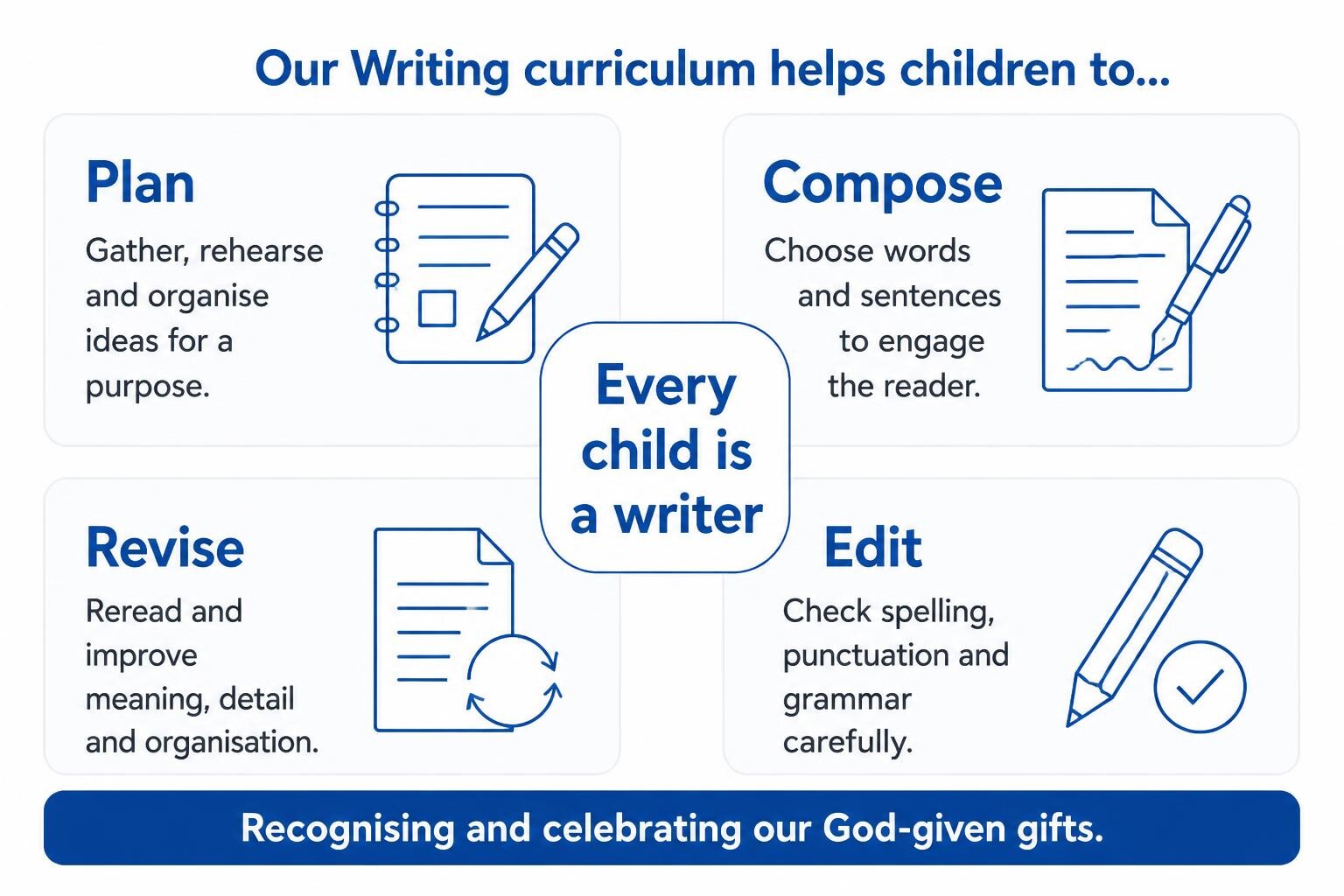
Children learn to plan, draft and reread their work, revising ideas and language to improve meaning and effect, and editing to improve accuracy. Explicit vocabulary and grammar teaching helps them understand, discuss and make purposeful choices as writers.
Handwriting is taught using Little Wandle in Reception and Year 1, and Letter-join in Years 2 to 6, supporting the development of legible, increasingly fluent writing.
Impact
Children demonstrate progress in writing through increasingly clear organisation, accurate spelling and punctuation, and greater control of sentence structure. They make purposeful vocabulary choices and adapt their language to suit different audiences and purposes. They develop confidence and independence in planning, drafting, revising and editing, using feedback to improve the clarity and effect of their writing.
Through discussion and review of writing across the curriculum, teachers assess how well children retain and apply their learning. This identifies misconceptions and informs further teaching, practice or challenge. Children become increasingly confident writers who can communicate ideas, information and imagination effectively.